
Oxygen Cages for Dogs: When to Use One, What to Set and How to Monitor
A clinical guide for veterinary teams: when a dog needs an oxygen cage, what oxygen, temperature and humidity to set, how to monitor, and how to wean a dog back to room air.
VetFlex Editorial Team
Veterinary Equipment Specialists
A nine-year-old Labrador comes through the door with his elbows pushed out, neck extended and flanks working hard. He won't lie down. He is too stressed for a mask and too unstable for much handling. For dogs like him, an oxygen cage is often the fastest way to raise the oxygen he breathes while the team works out what is causing the distress.
Used well, a dog oxygen cage buys time with very little stress. Used carelessly, it can overheat a panting dog, let CO₂ build up or give a false sense that the patient is being watched. This guide covers when to reach for the cage, what to set, what to watch, and how to step a dog back down to room air.
Quick answer
An oxygen cage for dogs is a sealed hospital enclosure that raises the oxygen a dog breathes, typically to 40 to 60%, without a mask or restraint.
Use it for dogs in respiratory distress or with low oxygen levels who don't tolerate handling.
Keep the cage cool, clear CO₂, open it as little as possible, and lower the oxygen as soon as the dog improves.
Key points
- Hypoxemia in dogs is usually defined as PaO₂ below 80 mmHg or SpO₂ below 95%.
- A well-sealed oxygen cage can reach about 60% oxygen; a mask or flow-by reaches roughly 25 to 45%.
- Panting dogs overheat fast in a closed cage, so temperature control matters as much as oxygen.
- Every door opening dilutes the oxygen, so plan handling and use access ports.
- Lower the oxygen in small steps once the dog is stable, and reassess after each step.
When does a dog need an oxygen cage?
The usual trigger is respiratory distress, with or without measured hypoxemia. Watch for:
- Fast or labored breathing, often with the abdomen working hard
- Neck extended and elbows held away from the chest
- Open-mouth breathing in a dog that isn't hot or exercising
- Restlessness, or refusing to lie down
- Pale, gray or blue gums or tongue
Where you can measure it, hypoxemia in dogs is generally defined as a PaO₂ below 80 mmHg or an SpO₂ below 95% (Ramesh et al., 2021). Common reasons dogs need supplemental oxygen include pneumonia, congestive heart failure, pulmonary contusions after trauma, upper airway obstruction and brachycephalic airway disease.
A cage suits dogs that are stressed by handling or won't tolerate a mask or nasal line. Severe cases may need more than a cage can offer. Kaplan (2023) lists an oxygen need above 60%, fatigue, PaCO₂ above 60 mmHg, PaO₂ below 60 mmHg or a severe upper airway obstruction as reasons to consider intubation instead.
How an oxygen cage compares with other ways to give dogs oxygen
| Method | Typical oxygen reached | Good for | Trade-offs |
|---|---|---|---|
| Flow-by | About 25–45% | Brief support, very fragile patients | Low and variable; ties up a team member |
| Face mask | About 35–45% | Short-term support in calm dogs | Many dogs resist; must not seal tight |
| Nasal cannula | About 30–70%, flow-dependent | Longer stays, larger dogs | Placement, comfort, dislodging |
| Oxygen cage | Up to about 60% | Stressed dogs, hands-off care | Oxygen drops when opened; heat and CO₂ need control |
Figures from Ramesh et al. (2021) and Kaplan (2023). Oxygen therapy for dogs can be delivered all of these ways; the cage's biggest advantage is that nothing touches the patient. For a dog that panics when restrained, that alone can lower oxygen demand.
What to set: oxygen, temperature and humidity
Oxygen
Start at a level that eases the dog's breathing, commonly 40 to 50%, and adjust to the clinical response and SpO₂. The aim is the lowest oxygen level that controls the signs. Published guidance is to bring very high concentrations down within the first 12 to 24 hours, because prolonged high oxygen carries a risk of oxygen toxicity (Ramesh et al., 2021). The attending veterinarian sets the target.
Temperature
This is the setting most often underestimated. A panting dog in a closed box warms the air quickly, and hyperthermia is a recognized risk of oxygen cages when temperature and humidity aren't controlled (Ramesh et al., 2021). Brachycephalic dogs are the most vulnerable. Use a cage that can actively cool, keep the setting on the cool side, and check the dog's rectal temperature, not just the cage display. Our guide to brachycephalic dogs in oxygen cages goes deeper.
Humidity
Dry oxygen dries the airways over longer stays, but a damp cage adds heat stress. Add humidity with the nebulizer when needed, and lower the cage temperature if humidity climbs.
CO₂
A sealed cage without CO₂ removal lets exhaled CO₂ build up, which can harm the patient (Ramesh et al., 2021). Older cages absorb it with soda lime, which has to be replaced as it is used up. Soda lime-free ICUs, including VetFlex's, clear it by exchanging chamber air with fresh air. Either way, check that CO₂ is being controlled before you rely on the oxygen reading. See soda lime vs soda lime-free ICUs, or read how veterinary oxygen cages work in clinical settings.
Monitoring a dog in an oxygen cage
A cage protects the patient from handling, but it also puts a wall between the dog and the team. Monitoring has to be deliberate.
- Respiratory rate and effort: continuously, by eye, through the window.
- SpO₂: published guidance for dogs on oxygen therapy suggests every 1 to 2 hours early on, more often if the dog is unstable.
- Body temperature: every 2 to 4 hours, and sooner if the dog is panting hard.
- Blood gases: when available, to confirm the trend.
- Comfort and position: a dog that can't lie down comfortably still needs support.
The cage display shows the air in the chamber, not the dog's oxygenation. Treat it as one input, not the answer.
Opening the door: each opening lets room air in, and the cage needs time to recover its oxygen level. Batch treatments and checks, use access ports for lines and quick tasks, and keep full-door openings short.
Choosing an oxygen cage for dogs: size matters
Traditional oxygen cages were built around cats and small dogs, and references have long noted that they are poorly suited to large patients because of their size and the risk of rapid overheating (Ramesh et al., 2021). A large dog needs room to lie flat on its side, stand and turn without pressing against the walls. When choosing a canine oxygen cage, compare interior chamber dimensions, not the outside footprint, and confirm that the cooling can keep up with a large, panting dog.
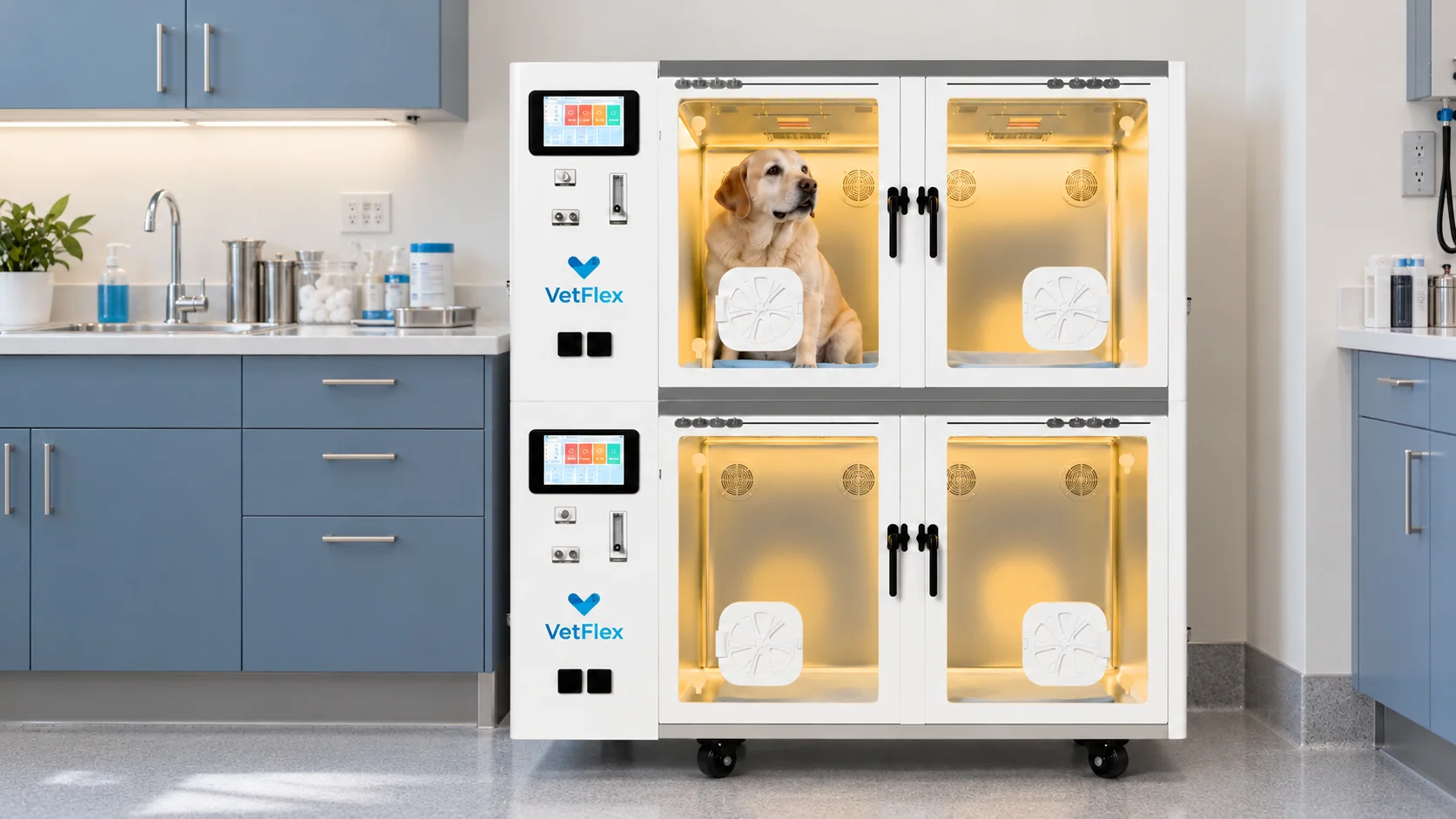
For reference, the larger VetFlex ICU Pro Duo XL chambers measure about 47.9 × 28.0 × 28.3 inches inside, and each chamber can be set to its own oxygen level, so a dog and a second patient can be treated side by side.
"The [VetFlex] ICU allows us to give precise, customized care to each patient… It's an incredible tool for animals with severe respiratory disease or in post-op recovery."
Weaning a dog off oxygen
Start weaning once the underlying problem is improving and the dog is breathing comfortably. Stability markers used in published guidance include a respiratory rate under 40, SpO₂ above 95% or PaO₂ above 80 mmHg (Ramesh et al., 2021).
- Step 1: Lower the oxygen by about 5 to 10% at a time.
- Step 2: Reassess breathing, SpO₂ and comfort after 1 to 2 hours.
- Step 3: If the dog stays stable, take the next step down.
- Step 4: If breathing worsens, return to the last level that worked.
- Step 5: Before moving the dog out, confirm it holds steady at or near room air (21%).
Go more slowly with small or fragile patients.
Planning oxygen cage capacity for your hospital
If dogs are waiting for the cage, or cats and dogs are competing for one unit, it may be time to add capacity. Three things to check:
- Oxygen source: a concentrator, cylinders or a central line. For concentrators, plan on at least 10 L/min of output. See concentrator vs tank vs central oxygen.
- Chambers: a dual-chamber unit lets you run two patients at different oxygen levels.
- Cooling and CO₂ control: essential for large and brachycephalic dogs.
Our clinic guide to oxygen cages for dogs and cats covers sizing, installation and models in more detail.
This article is for veterinary professionals and is not a substitute for clinical judgment. Treatment decisions belong to the attending veterinarian.
Download Product Specifications
Get ICU System Pricing & Specifications
Fill out the form below and our team will reach out within 24 hours.
Frequently asked questions
How long can a dog stay in an oxygen cage?
What oxygen level should an oxygen cage be set to for a dog?
Is an oxygen kennel for dogs the same as an oxygen cage?
Can I use an oxygen cage for dogs at home?
Why do dogs overheat in oxygen cages?
Next steps
VetFlex ICUs control oxygen from 21 to 80%, heat and cool the chamber, clear CO₂ without soda lime and run under 40 dB, so dogs can rest while the team watches.
See the ICU in action
Compare veterinary oxygen cagesReferences
Related Decision Guides
ICU Oxygen Cage Buying Guide
Compare features, costs, and choose the right system for your practice.
Read GuideSoda Lime vs Soda Lime-Free ICU
Understand the clinical and financial case for eliminating soda lime.
Read GuideBest Veterinary Oxygen Cage
Evaluate features, monitoring, and cost of ownership across systems.
Read GuideContinue reading: Feline respiratory distress in veterinary ICUs · ICU planning for enterprise veterinary groups
ICU & Critical Care Equipment
Need oxygen without central O₂? Explore the VetFlex Veterinary Oxygen Concentrator
How did you find this article?
Was this article helpful?
Your feedback helps us understand what content matters most to you.
Related Clinical Insights
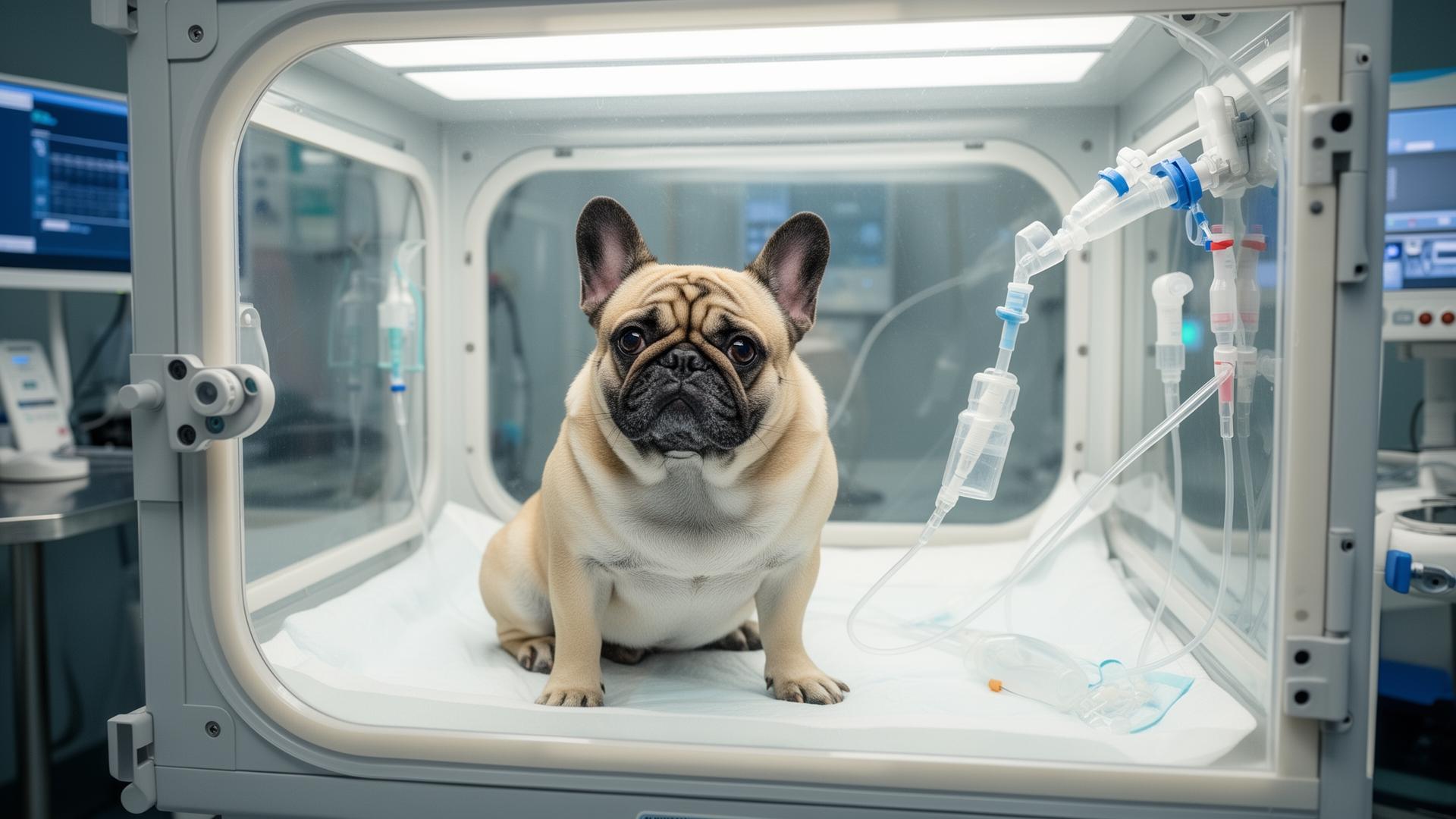
Brachycephalic Dogs and Oxygen Cages: Supporting Flat-Faced Breeds in Respiratory Distress
A clinical guide to managing brachycephalic respiratory emergencies with veterinary oxygen cages, covering BOAS pathophysiology, treatment protocols, and ICU equipment selection.
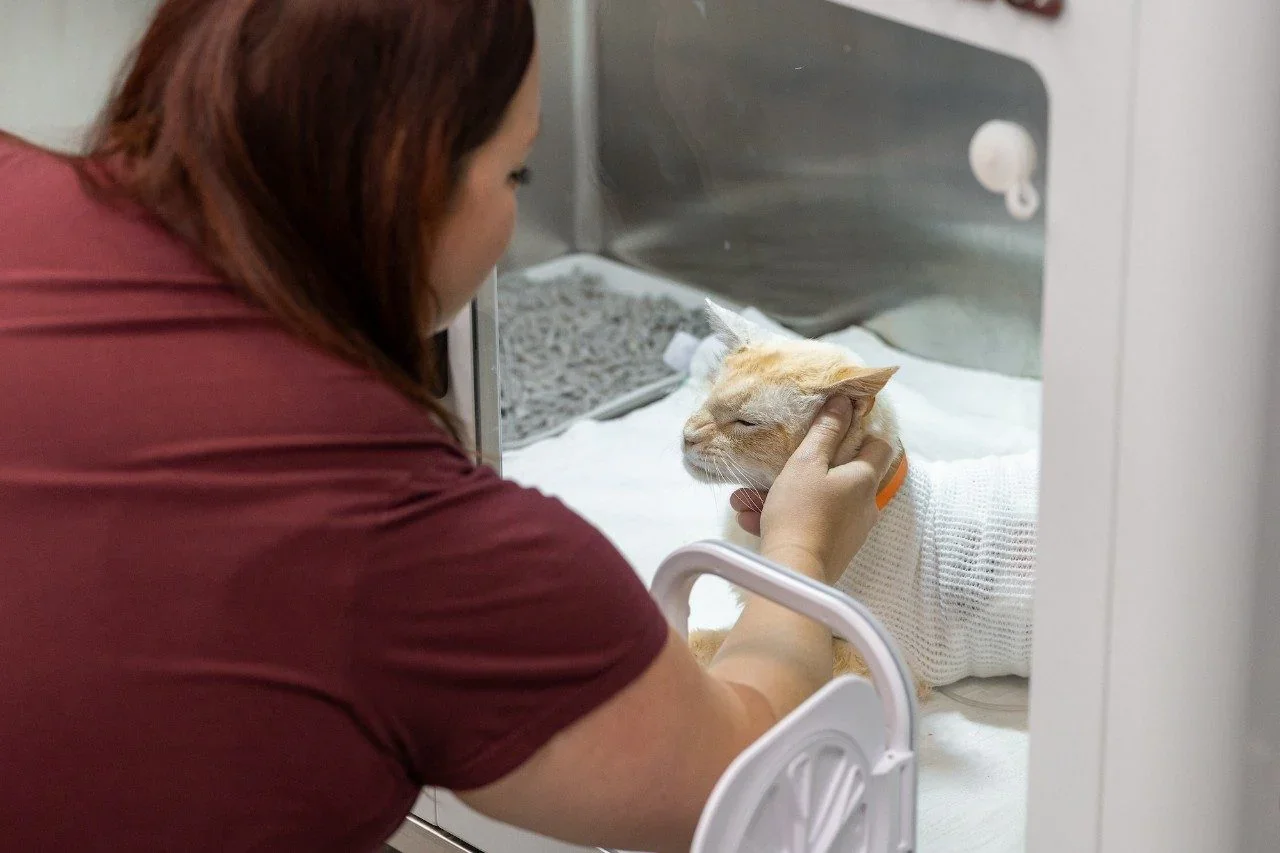
How Virginia Tech Is Using VetFlex Oxygen Cage Technology to Transform Veterinary Oxygen Care
Virginia-Maryland College of Veterinary Medicine at Virginia Tech has officially installed the VetFlex ICU oxygen cage system in their state-of-the-art Veterinary Teaching Hospital, marking a huge step forward for animal health.

Why Soda Lime-Free Oxygen Cages Are the Future of Veterinary Care
Veterinary medicine is advancing rapidly, with an emphasis on technologies that enhance patient outcomes while reducing operational challenges. One of the most transformative innovations is the soda lime-free oxygen cage system.