0% APR Financing AvailableView ICU financing options
    VetFlex Logo
    Oxygen Cage Guide

    How to Choose a Veterinary Oxygen Cage

    Look for controlled oxygen delivery, active CO₂ management, temperature controls and usable patient space when choosing a veterinary oxygen cage. Compare monitoring, oxygen source compatibility, cleaning, backup power and operating costs before buying. A small animal oxygen cage, oxygen kennel or veterinary ICU cage should be selected for the hospital's patients and workflow, not the label alone.

    Quick answer

    Choose an oxygen cage by patient fit, oxygen control and CO₂ removal.

    Check monitoring, cleaning access and backup power before buying.

    Key points

    • Compare usable chamber dimensions.
    • Review oxygen and CO₂ controls together.
    • Check the oxygen source and power supply.
    • Plan cleaning, staff training and backup care.
    • Compare operating costs separately from the equipment quote.

    For animal use only. Not for human use.

    Compare system types, understand what features drive clinical outcomes, and determine the best fit for your practice.

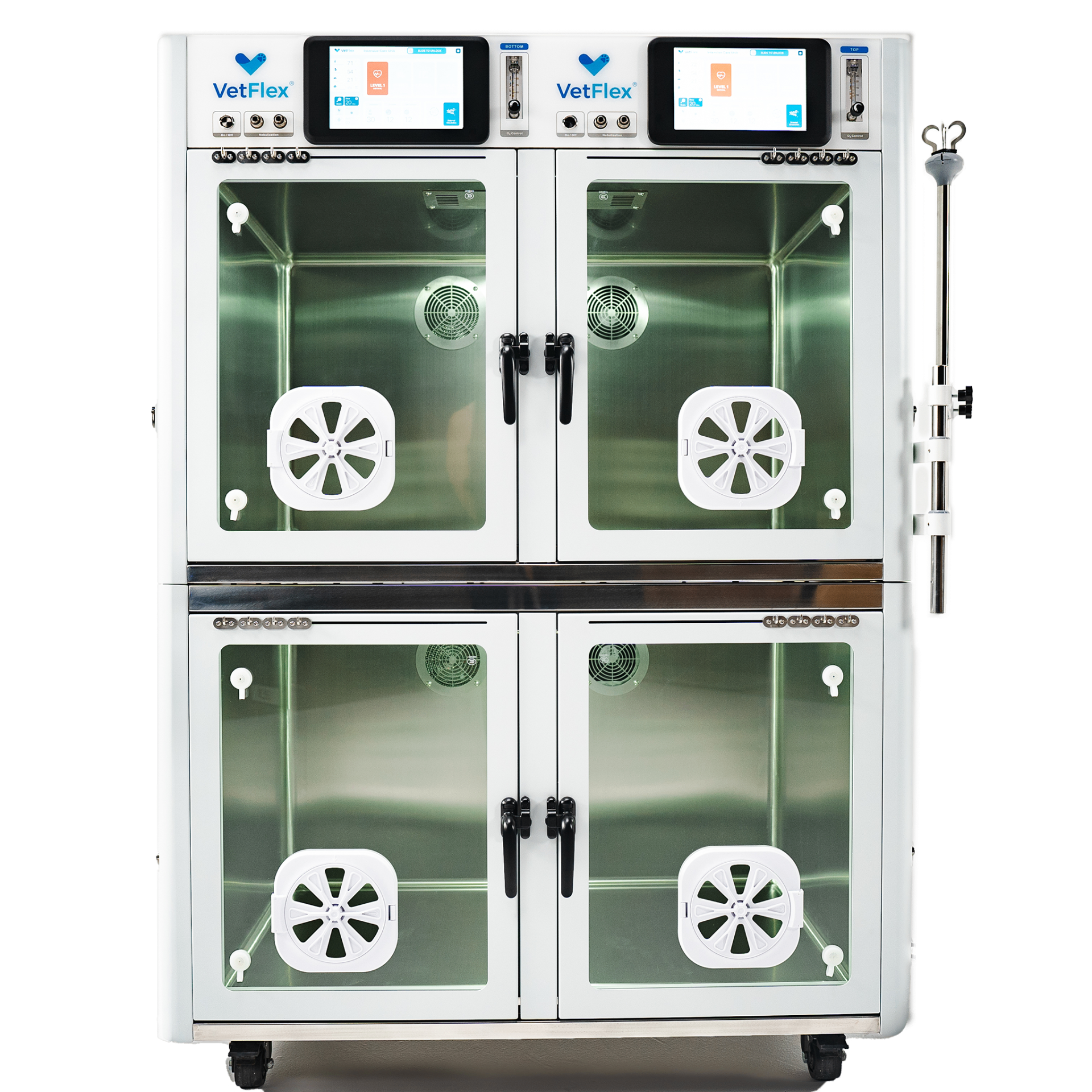
    VetFlex ICU Pro Duo veterinary oxygen cage system

    Most clinics selecting an oxygen cage are evaluating more than just oxygen delivery. The best systems combine precise environmental control, real time monitoring, and low maintenance operation. The challenge is separating genuine clinical value from marketing claims.

    This guide is designed to help veterinary clinics evaluate oxygen cage systems based on real world clinical requirements and operational considerations.

    The Problem

    Why Clinics Are Reevaluating

    Inconsistent oxygen levels in basic enclosures without monitoring

    Lack of temperature control beyond simple heating

    No real time CO₂ or O₂ monitoring on entry level systems

    High ongoing consumable costs with soda lime based systems

    Limited scalability when practice volume grows

    Noise levels that increase patient stress during recovery

    Evaluation Framework

    What to Consider

    1

    Oxygen Delivery Method

    How does the system manage oxygen concentration? Active monitoring and closed loop control provide more consistent levels than passive flow systems.

    2

    CO₂ Management

    Does the system actively remove CO₂? Soda lime systems require ongoing consumable replacement. Electronic ventilation eliminates this entirely.

    3

    Environmental Controls

    Evaluate temperature range, humidity management, and lighting options. Advanced systems offer both heating and cooling with precise control.

    4

    Monitoring and Alerts

    Real time display of O₂ and CO₂ levels with automated alerts is critical for patient safety. Basic systems often lack these capabilities.

    5

    Build Quality and Durability

    Stainless steel construction, quality seals, and medical grade components determine long term reliability and infection control.

    Compare the published VetFlex ICU model specifications

    ICU modelConfigurationInternal L × W × H
    VetFlex ICU ProOne oxygen chamber24.4 × 42.0 × 23.9 inches
    VetFlex ICU Pro HybridOne oxygen chamber plus recovery space24.4 × 42.0 × 23.9 inches, oxygen chamber
    VetFlex ICU Pro DuoDual oxygen chambers, independent controls24.4 × 42.0 × 23.9 inches per chamber
    VetFlex ICU Pro Duo XLDual larger oxygen chambers, independent controls28.0 × 47.9 × 28.3 inches per chamber

    Compare VetFlex ICU Pro, VetFlex ICU Pro Hybrid, VetFlex ICU Pro Duo, VetFlex ICU Pro Duo XL. The Pro is a single oxygen chamber, not the Pro Duo. The Hybrid combines an oxygen chamber with recovery space; it should not be described as two independently controlled oxygen chambers.

    The Pro Duo provides dual oxygen chambers, and the XL adds larger internal dimensions. Match actual patient measurements, positioning and access requirements to these dimensions. The published specifications do not provide a patient weight limit, so do not select solely by a guessed kilogram or pound rating.

    Placement, oxygen supply and backup planning

    The published specification sheets list central oxygen, oxygen concentrator and tank compatibility. The compatible VetFlex concentrator supplies 10 LPM; the cage controls and external oxygen source are different parts of the system.

    Confirm source capacity against the intended configuration and concurrent patient use with the clinical team. Check 110V/10A power, the 30 minute integrated UPS specification and 3 inches of ventilation clearance on all sides.

    Backup capacity does not replace the hospital's outage and patient observation procedures.

    Published ICU features include 304 stainless steel construction, a 10 inch touchscreen, real time CO₂ sensors, 60°F to 99°F temperature control, under 40 dB operation and a two year warranty subject to written terms.

    For Duo configurations, controls are independent per chamber. Review cleaning access, seals and equipment operating instructions with staff. Ion air treatment does not replace physical cleaning and disinfection. Compare the specification sheet for the exact model rather than transferring every feature or dimension between configurations.

    Operating cost is not the equipment purchase price

    The existing cost guide models 1 unit over 5 years. Its default traditional operating total is $35,000, VetFlex is $3,500, and the estimated difference is $31,500. Annual traditional assumptions are $3,000 soda lime, $800 maintenance, $1,500 consumable related staff labor, $500 energy and $1,200 other consumables.

    VetFlex models $200 annual maintenance and the same $500 energy, with $0 soda lime, consumable related labor and other consumables. These are editable operating assumptions, not a purchase quote or guaranteed savings.

    Use ICU cost of ownership to change the inputs for your hospital. For equipment pricing, use the existing Request Pricing form below and describe the model, patient mix, room constraints and oxygen source.

    Compare warranty coverage, service and maintenance alongside the purchase proposal. A single chamber can be an initial configuration, but confirm the supported expansion or upgrade path with VetFlex rather than assuming every additional chamber is an interchangeable attachment.

    Side by Side

    Direct Comparison

    Feature
    Advanced ICU Cage (e.g. VetFlex)
    Basic Oxygen Enclosure
    O₂ Monitoring
    Real time digital display with alerts
    Manual flow meter only
    CO₂ Management
    AERAFLOW™ electronic ventilation
    Soda lime or passive venting
    Temperature Control
    Active heating and cooling (60°F to 99°F)
    Heating only or no control
    Noise Level
    Under 40 dB
    40 to 60 dB typical
    Consumable Costs
    $0 per year
    $1,500 to $3,000 est. per unit/year
    Sterilization
    Ion based air purification
    Manual cleaning only
    Backup Power
    30 minute battery backup
    Not available
    Modularity
    Upgradable and expandable
    Fixed configuration
    Best Fit For
    Clinics that prioritize monitoring, environmental control, and long term operating analysis
    Low volume practices with basic oxygen therapy needs

    High volume clinics often prioritize systems that reduce ongoing maintenance and consumable dependency.

    Our Solution

    Our recommendation for busy ER and specialty hospitals

    Start with the ICU Pro Duo, our most popular ICU. Two independently controlled chambers support multiple patients in one footprint, with the same soda lime free design. Confirm patient fit and oxygen supply with your clinical team.

    Compare the single chamber veterinary oxygen cage with the ICU Pro Duo for two independently controlled chambers.

    Avoid These Pitfalls

    Common Buying Mistakes

    Evaluating oxygen delivery without considering CO₂

    Oxygen enrichment alone is not sufficient. Without active CO₂ removal, dangerous levels can accumulate in sealed enclosures.

    Choosing the cheapest option without calculating ongoing costs

    Basic enclosures with soda lime may have higher recurring consumable expense over five years. Compare documented usage, local pricing, service, energy, and other operating assumptions.

    Ignoring noise levels

    ICU patients are critically ill. Noise is one factor teams may consider when designing a quieter recovery environment; actual patient response varies.

    Not considering future growth

    Fixed configuration systems require full replacement when practice volume increases. Modular designs protect your investment.

    Is It Right for You?

    When This Makes Sense

    Clinics adding oxygen therapy to their critical care capability

    Emergency hospitals requiring reliable, monitored oxygen delivery

    Practices replacing aging or underperforming ICU equipment

    Multi unit environments requiring consistent performance across cages

    Clinics evaluating total cost of ownership across a five year period

    Applications

    Common Use Cases

    Critical Care Recovery

    Post surgical patients requiring precise oxygen delivery, temperature control, and continuous monitoring.

    Emergency Medicine

    Respiratory distress, trauma stabilization, and overnight monitoring in busy emergency departments.

    Specialty Referral

    Advanced cases requiring multi parameter environmental control and real time patient status visibility.

    FAQ

    Frequently Asked Questions

    The published VetFlex ICU specifications list central oxygen, oxygen concentrators and oxygen tanks. Review supply capacity for the intended configuration; the compatible VetFlex concentrator is rated at 10 LPM.

    Allow 3 inches of ventilation clearance on all sides and review the exact external dimensions. Published specifications list 110V/10A and a 30 minute integrated UPS. Confirm installation and outage procedures with the hospital team.

    Compare actual patient measurements with published internal dimensions. Standard oxygen chambers are 24.4 × 42.0 × 23.9 inches; Pro Duo XL chambers are 28.0 × 47.9 × 28.3 inches. The reviewed specifications do not publish verified patient weight limits.

    A proper oxygen cage provides sealed environmental control with active CO₂ management, temperature regulation, and real time gas monitoring. A kennel with supplemental oxygen lacks these capabilities and cannot maintain consistent therapeutic levels.

    Critical. In sealed enclosures, CO₂ accumulates as patients exhale. Without active removal and monitoring, CO₂ levels can reach dangerous concentrations. AERAFLOW™ technology addresses this by continuously exchanging air electronically.

    The best systems offer both heating and cooling with a range of at least 60°F to 99°F. Single mode systems that only heat cannot serve hypothermic and hyperthermic patients effectively.

    With modular systems like VetFlex, yes. You can start with a single chamber and upgrade or add chambers as patient volume grows.

    Focus on five categories: CO₂ management method, monitoring capabilities, temperature control range, consumable costs, and warranty coverage. These factors determine both clinical quality and total cost of ownership.

    Well built stainless steel ICU cages with electronic ventilation are designed to last 10 or more years with minimal maintenance. Systems relying on chemical consumables may require more frequent component replacement.
    Get Started

    Next Steps

    Ready to Make the Right Decision for Your Clinic?

    Tell us a bit about your clinic and what you are evaluating. We will send relevant specifications and pricing.

    Our team will follow up with recommendations based on your clinic's needs.

    More buying guides