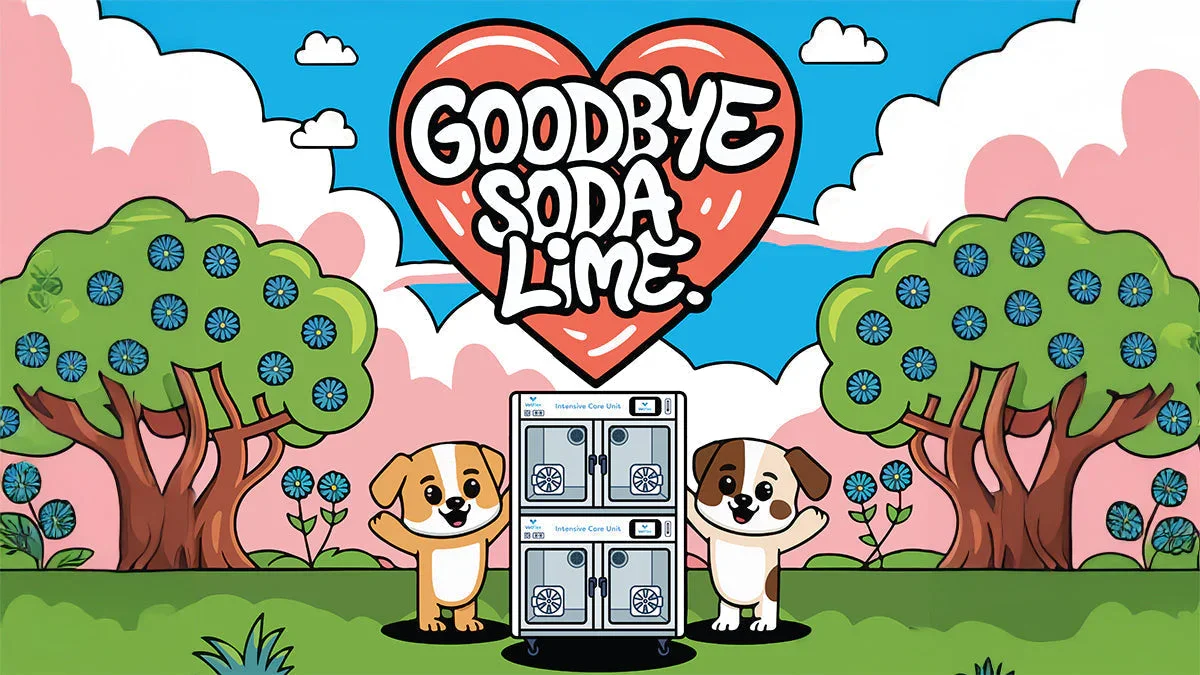
Sustainable Veterinary Practices: Soda Lime Free ICU and Natrle Gloves
Start with soda lime free ICU workflow and documented Natrle exam glove claims. The shared default five year operating estimate is $35,000 traditional versus $3,500 VetFlex, excluding purchase price.
AERAFLOW™ replaces soda lime CO₂ absorption with fresh air exchange. Natrle exam gloves add documented landfill biodegradation testing. Keep clinical requirements, editable operating assumptions and environmental test conditions separate.
Quick answer
Sustainable purchasing starts with the clinical task and documented product facts.
Soda lime free ICUs remove a canister task, not every running cost.
Glove test results need their stated test conditions.
Key points
- AERAFLOW uses fresh air exchange for CO₂ removal.
- Cleaning, electricity and service still matter.
- Use local inputs when comparing operating costs.
- Keep exam and surgical glove materials separate.
- NATRLE exam gloves: 81% in 490 days under ASTM D5511 landfill test conditions.
- Actual biodegradation rates vary with landfill conditions.
Last reviewed by VetFlex Clinical Education Team: March 13, 2026
Key Topics Covered
Eco-friendly gloves and single-use supplies for veterinary practices
Eliminating soda lime and reducing hazardous waste streams
ICU systems and oxygen concentrators with lower environmental footprint
Operational strategies for sustainable veterinary hospitals
How environmental initiatives reduce long-term practice costs
Soda lime free ICU operation: remove a consumable task, not every cost
Traditional soda lime ICU systems manage CO₂ through chemical absorption, which requires canister purchasing, storage, handling and replacement. VetFlex AERAFLOW™ uses continuous fresh air exchange instead. The useful sustainability comparison is the soda lime consumable workflow and associated waste stream, not a claim that the entire hospital produces no waste.
Cleaning, service, energy and other supplies remain part of a hospital's operations. This guide brings together the existing sustainable equipment and cost focused articles without carrying forward conflicting cost assumptions.
The existing ICU cost of ownership page models one unit over five years: $35,000 traditional operating cost, $3,500 VetFlex and $31,500 estimated difference. These figures use editable assumptions and exclude equipment purchase. They are not guaranteed savings or a universal hospital budget. Compare them with the actual clinical workload and local operating costs before treating the difference as a purchasing forecast.
| Five year operating category | Traditional default | VetFlex default |
|---|---|---|
| Soda Lime Consumables | $15,000 | $0 |
| Maintenance and Repairs | $4,000 | $1,000 |
| Staff Labor (Consumables) | $7,500 | $0 |
| Energy | $2,500 | $2,500 |
| Other Consumables | $6,000 | $0 |
Annual traditional inputs are $3,000 soda lime, $1,200 other consumables, $800 maintenance, $1,500 consumable related staff labor and $500 energy. The VetFlex side models $200 maintenance and $500 energy, with $0 in the soda lime, other consumables and consumable labor categories.
A zero modeled category is not proof that no staff time, cleaning or supplies are ever required. Use the shared calculator to adjust those assumptions instead of adding disposal fees, carbon savings or clinical outcome statistics not established by the cost page.
Procurement and workflow: review the tasks the system actually changes
The merged articles identify consumable procurement, canister handling and replacement as practical operational issues. A ventilation approach that does not use soda lime removes that canister task from the ICU workflow.
Teams still need a cleaning and service plan and a suitable oxygen source. Review AERAFLOW™ technology, ICU solutions and the Veterinary Oxygen Cage Buying Guide when evaluating equipment. The clinical and facilities requirements should remain the starting point for any sustainability decision.
For hospitals planning several independent spaces, compare the actual configurations and their oxygen supply requirements rather than assuming the same unit count means the same capacity. The Pro, Pro Hybrid, Pro Duo and Pro Duo XL are distinct configurations.
Request a proposal from the product page and keep purchase price separate from the editable five year operating model. Existing institutional stories such as Virginia Tech's installation provide implementation context, not a universal return on investment.
Natrle biodegradable examination gloves: a separate published claim
Natrle exam gloves use EcoDegra™ technology in a latex free, powder free nitrile examination product. NATRLE exam gloves reached 81% biodegradation in 490 days under ASTM D5511 landfill test conditions.
Conventional nitrile can take 100+ years. Actual rates vary with landfill conditions. That qualification belongs with the claim. It describes the exam line and the stated test context, not a guaranteed timeline for every discarded glove or a carbon footprint calculation.
Natrle sterile surgical gloves are natural rubber latex and are not the biodegradable nitrile examination line. Keep those materials, uses and packaging separate in purchasing records and environmental communications. For the buyer range, use Natrle; for the test interpretation, use are nitrile gloves biodegradable?. The veterinary glove buying guide compares clinical types and ASTM D6978 chemotherapy testing alongside the environmental attribute.
Packaging count and unit price are different questions
Published Natrle exam prices are $6.99 for 100 gloves, $13.98 for 200, $69.90 for 1,000 and $139.80 for 2,000. Each equals $0.0699 per glove. At the same usage, 1,000 gloves means ten 100 count boxes or five 200 count boxes, so count changes the number of boxes handled without changing those listed unit prices.
Use 200 versus 100 count gloves for the published box dimensions, case volume and storage comparison rather than inventing a packaging weight or carbon estimate.
Sustainable procurement should preserve the required clinical specifications. Natrle exam documentation lists ASTM D6319, AQL 1.5 and ASTM D6978 testing. For hazardous drug tasks, review the specific drug permeation data and the facility's procedures. Biodegradability alone is not evidence of chemotherapy suitability or sterility. The chemo rated glove guide explains that separate decision. Check size, box count and ordering unit before standardizing a product across locations.
Keep sustainability decisions measurable and clinically appropriate
The source articles also discuss waste segregation, reusable alternatives where clinically appropriate, and reviewing procurement and operating tasks together. Those are decisions to assess against the hospital's procedures, not blanket instructions to reuse a disposable clinical product.
Begin with published product specifications and documented cost inputs. Do not carry a biodegradation result into a different material, turn a modeled operating difference into guaranteed savings, or substitute an equipment air treatment feature for cleaning and disinfection.
Sustainable Consumables
Biodegradable gloves and eco-friendly supplies
Equipment & Technology
Soda lime-free ICU and efficient equipment